

Essential oil of Mentha aquatic var. Kenting Water Mint suppresses two-stage skin carcinogenesis accelerated by BRAF inhibitor vemurafenib
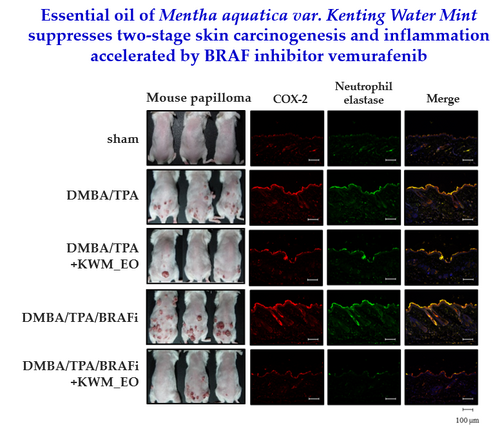
Epidemiological evidence reveals that a BRAF inhibitor (BRAFi) drug vemurafenib (PLX4032) for treating late-stage melanoma could cause cutaneous squamous cell carcinoma in cancer patients with the most prevalent HRASQ61L mutation. In a two-stage skin carcinogenesis mouse model, the skin papillomas induced by 7,12-dimethylbenz[a]anthracene (DMBA)/12-O-tetradecanoylphorbol-13-acetate (TPA) resemble the lesions in BRAF inhibitor-treated patients. We investigated the bioactivity of Mentha aquatica var. Kenting Water Mint essential oil (KWM) against PDV cells, mouse keratinocytes bearing HRASQ61L mutation, and its effect on inhibiting papilloma formation in a two stage skin carcinogenesis mouse model, with or without PLX4032 co-treatment. The results revealed that KWM-EO effectively attenuated cell viability, colony formation, and the invasive and migratory abilities of PDV cells. KWM-EO treatment significantly decreased the formation of cutaneous papilloma in DMBA/TPA mice or in BRAFi PLX4032 further irritated DMBA/TPA mice (DMBA/TPA/BRAFi). Immunohistochemistry analyses showed that infiltration of inflammatory cell infiltration (neutrophils/elastase, macrophages/F4/80), and overexpression of keratin14 and COX-2 in DMBA/TPA and DMBA/TPA/BRAFi mice skins were profoundly suppressed by KWM-EO treatment. This study demonstrates that KWM-EO has chemopreventive effects against PLX4032-induced cutaneous side-effects in a DMBA/TPA-induced two-stage carcinogenesis model and that is worth further exploration for possible application in melanoma patients.
(2019) Molecules, 24, 2344