


DCL2- and RDR6-dependent transitive silencing of SMXL4 and SMXL5 in Arabidopsis dcl4 mutants causes defective phloem transport and carbohydrate over-accumulation
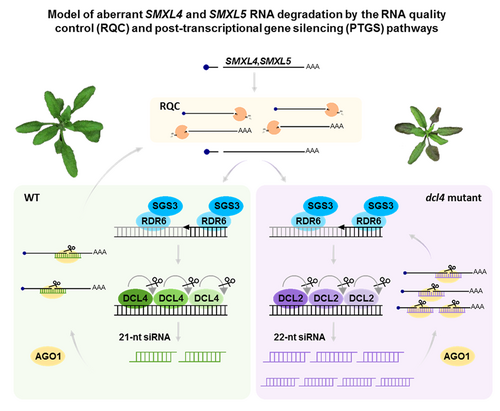
Dicer-Like (DCL) enzymes are able to process double-stranded RNA into small RNAs. Arabidopsis DCL4 and DCL2 each allow the post-transcriptional gene silencing (PTGS) of viruses and transgenes, but DCL2 activity is mostly obscured by DCL4. This hierarchy likely prevents DCL2 having any detrimental effects on endogenous genes. Indeed, dcl4 mutants exhibit leaf pigmentation under regular growth conditions. Here we report that the purple phenotype of dcl4 leaves correlates with carbohydrate over-accumulation and defective phloem transport, and depends on the activity of DCL2 and two enzymes, Suppressor of Gene Silencing 3 (SGS3) and RNA-Dependent RNA Polymerase 6 (RDR6), involved in double-stranded RNA synthesis. Further, this phenotype correlates with the down-regulation of two genes expressed in the apex and the vasculature, SMAX1-Like 4 (SMXL4) and SMXL5, and the accumulation of DCL2- and RDR6-dependent small interfering RNAs derived from these two genes. Supporting a causal effect, smxl4 smxl5 double mutants exhibit leaf pigmentation, enhanced starch accumulation and defective phloem transport, similar to dcl4 plants. Overall, this study elucidates the detrimental action of DCL2 when DCL4 is absent, and indicates that DCL4 outcompeting DCL2 in wild-type plants is crucial to prevent the degradation of endogenous transcripts by DCL2- and RDR6-dependent transitive PTGS.
(2017) The Plant Journal, 90(6):1064-1078