

Identification of Chlorophyll Dephytylase Involved in Chlorophyll Turnover
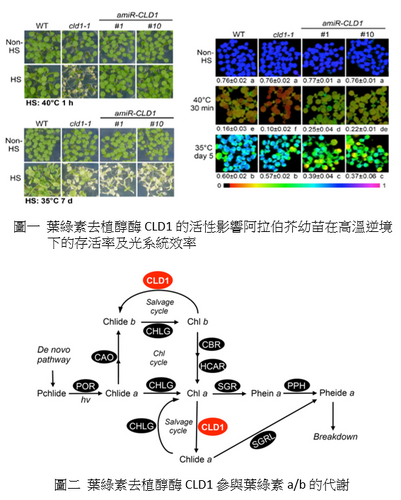
In photosynthesis, chlorophylls absorb light energy, which is transformed into chemical energy by the multi-protein-pigment complex called photosystem. The photosystem, composing of chlorophylls and proteins, tends to be damaged during the process of photosynthesis. The plant cells must repair the damaged photosystem to maintain the photosynthetic efficiency, causing the bound chlorophylls to turnover. Previous studies suggest that chlorophylls in damaged photosystem would be salvaged by two successive steps: 1. Dephytylation of chlorophylls; 2. Rephytylation of the dephytylated chlorophylls (or chlorophyllides). The latter is catalyzed by chlorophyll synthase, but the enzyme involved in the first reaction has been enigmatic. More than a century, chlorophyllase has been the only enzyme known to hydrolyze chlorophyll into chlorophyllide in vitro. However, the role of chlorophyllase in chlorophyll catabolism remains controversial. In an effort in cloning the mutant gene responsible for a heat sensitive phenotype in Arabidopsis, we identified a novel chloroplast protein capable of hydrolyzing chlorophylls and named it chlorophyll dephytylase1 (CLD1). The results from genetic and biochemical experiments suggested that CLD1 is involved in the first step of the chlorophyll salvage cycle. Plants lacking CLD1 significantly reduced the photosynthetic efficiency and viability under prolonged heat stress, underscoring the importance of the chlorophyll salvage cycle for plant thermotolerance. The discovery of CLD1 fills the gap in chlorophyll metabolism and facilitates further studies in the understanding of photosystem repair and its regulation.
林耀斌、吳孟宸、 常怡雍 個人網站'> 常怡雍 * (2016) The Plant Cell, 28, 2974-2990