


The role of peptides cleaved from protein precursors in eliciting plant stress reactions
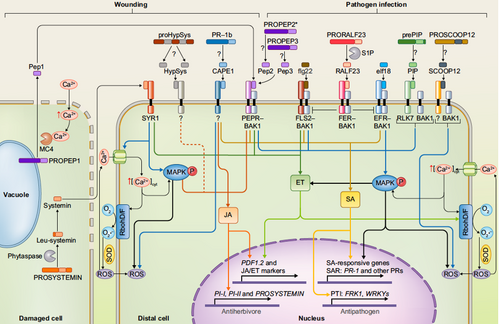
As sessile organisms, plants are exposed to diverse abiotic and biotic stresses, and thus have developed complex signaling mechanisms that orchestrate multiple stress responses. Plant peptides have recently emerged as key signaling molecules of stress responses, not only to mechanical wounding and pathogen infection but also to nutrient imbalance, drought and high salinity. The currently identified stress-related signaling peptides in plants are derived from proteolytic processing of protein precursors. Here, we review these protein-derived peptides and the evidence for their functions in stress signaling. We recommend potential research directions that could clarify their roles in stress biology, and propose possible crosstalk with regard to the physiological outcome. The stress-centric perspective allows us to highlight the crucial roles of peptides in regulating the dynamics of stress physiology. Inspired by historic and recent findings, we review how peptides initiate complex molecular interactions to coordinate biotic and abiotic stress responses in plants.
陳盈嵐、范凱亭、洪勝崎、陳逸然* (2019) New Phytologist,