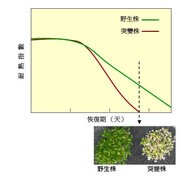

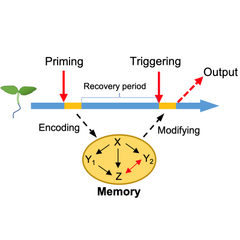
How do plants remember their stresses?
It was absurd to say plants have memory, but not anymore. Actually, all living organisms on Earth, from bacteria to blue whales, must correctly process and remember critical environmental information to respond to changes in a manner conduc...

Distinct heat shock factors and chromatin modifications mediate the organ-autonomous transcriptional memory of heat stress
Plants can be primed by a stress cue to mount a faster or stronger activation of defense mechanisms upon a subsequent stress. A crucial component of such stress priming is the modified reactivation of genes upon recurring stress; however, t...
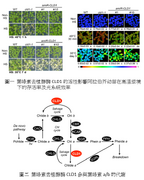
Identification of Chlorophyll Dephytylase Involved in Chlorophyll Turnover
In photosynthesis, chlorophylls absorb light energy, which is transformed into chemical energy by the multi-protein-pigment complex called photosystem. The photosystem, composing of chlorophylls and proteins, tends to be damaged during the ...

Analysis of an Arabidopsis heat-sensitive mutant reveals that CHLOROPHYLL SYNTHASE is involved in reutilization of chlorophyllide during chlorophyll turnover
Chlorophylls, the most abundant pigments in the photosynthetic apparatus, are constantly turned over accompanying the degradation and replacement of the damage-prone reaction center D1 protein of photosystem II. Results from isotope labelin...
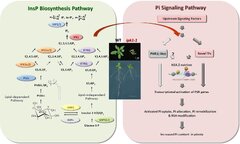
Arabidopsis inositol pentakisphosphate 2-kinase, AtIPK1, is required for growth and modulates phosphate homeostasis at the transcriptional level
Arabidopsis inositol pentakisphosphate 2-kinase, AtIPK1, is required for growth and modulates phosphate homeostasis at the transcriptional levelInositol hexakisphosphate (IP6) provides a phosphorous reservoir in plant seeds; in addition, al...
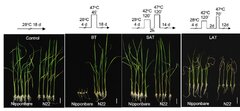
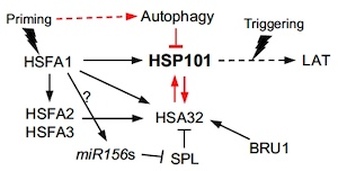
A Positive Feedback Loop between HSP101 and HSA32 Modulates Long-term Acquired Thermotolerance Illustrating Diverse Heat Stress Responses in Rice Varieties
Heat stress is an important factor that has a negative impact on rice production. To alleviate this problem, it is necessary to extensively understand the genetic basis of heat tolerance and adaptability to heat stress in rice. Here, we rep...
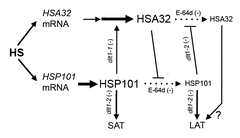
Interplay between Heat Shock Proteins, HSP101 and HSA32, Prolongs Heat Acclimation Memory Posttranscriptionally in Arabidopsis
Heat acclimation improves the tolerance of organisms to severe heat stress. Our previous work showed that in Arabidopsis the “memory” of heat acclimation treatment decayed faster in the absence of HSA32, a heat-induced protein predominantly...
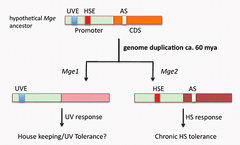
Recent gene duplication and subfunctionalization produced a mitochondrial GrpE, the nucleotide exchange factor of Hsp70 complex, specialized in thermotolerance to chronic heat stress in Arabidopsis
Duplication and divergence of heat stress (HS) response genes might help plants adapt to varied HS conditions, but little is known on the topic. In this study, we examined the evolution and function of Arabidopsis mitochondrial GrpE (Mge) p...
Temperature-induced lipocalin is required for basal and acquired thermotolerance in Arabidopsis
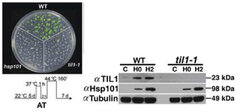
Lipocalins are a group of widely distributed proteins, and the plant lipocalins are unique in being temperature-induced. In this paper, we provide direct genetic evidence that the temperature-induced lipocalin (TIL1) is required for basal a...
A Heat-Inducible Transcription Factor, HsfA2, Is Required for Extension of Acquired Thermotolerance in Arabidopsis
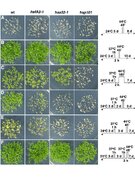
The expression of heat shock proteins (Hsps) induced by nonlethal heat treatment confers acquired thermotolerance (AT) to organisms against subsequent challenges of otherwise lethal temperature. After the stress signal is removed, AT gradua...