


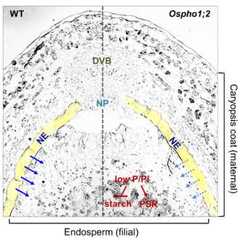
Maternal effect contributes to grain-filling defects of Ospho1;2 rice mutants
In seeds, filial and maternal tissues are symplastically isolated. Nutrient delivery through plasma membrane-localized transporters at the junction of filial and maternal tissues is indispensable for sustaining endosperm and embryo developm...
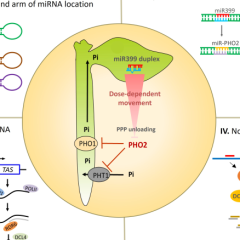
Dose-dependent long-distance movement of microRNA399 duplex regulates phosphate homeostasis in Arabidopsis
MicroRNA399 (miR399), a phosphate (Pi) starvation-induced long-distance signal, is first produced in shoots and moves to roots to suppress PHO2 encoding a ubiquitin conjugase, leading to enhanced Pi uptake and root-to-shoot translocation. H...
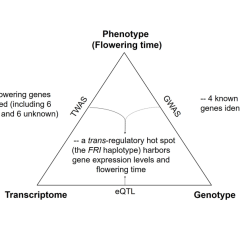
TWAS coupled with eQTL analysis reveals the genetic connection between gene expression and flowering time in Arabidopsis
Genome-wide association study (GWAS) has improved our understanding of complex traits, but challenges exist in distinguishing causation versus association caused by linkage disequilibrium. Instead, transcriptome-wide association studies (TW...
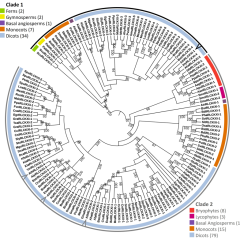
Conservation of land plant-specific receptor-like cytoplasmic kinase subfamily XI possessing a unique kinase insert domain
The number of genes encoding receptor-like kinases (RLKs) has expanded in the plant lineage. Their expansion has resulted in the emergence of diverse domain architectures that function in signaling cascades related to growth, development, a...
uORF and Phosphate-Regulated Expression of Rice OsNLA1 Controls Phosphate Transport and Reproduction
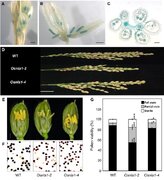
Rice (Oryza sativa) OsNLA1 has been proposed to play a crucial role in regulating phosphate (Pi) acquisition in roots, similar to that of Arabidopsis AtNLA. However, unlike AtNLA, OsNLA1 is not a target of miR827, a Pi starvation-induced mi...
Structure-Function Analysis Reveals Amino Acid Residues of Arabidopsis Phosphate Transporter At PHT1;1 Crucial for Its Activity
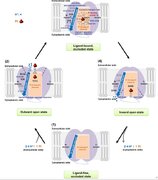
Phosphorus (P), an essential plant macronutrient, is acquired in the form of inorganic phosphate (Pi) by transporters located at the plasma membrane of root cells. To decipher the Pi transport mechanism, Arabidopsis thaliana Pi transporter ...

Phosphite-Mediated Suppression of Anthocyanin Accumulation Regulated by Mitochondrial ATP Synthesis and Sugar in Arabidopsis
Despite the essential role of phosphate (Pi) in plant growth and development, how plants sense and signal the change of Pi supply to adjust its uptake and utilization is not yet well understood. Pi itself has been proposed to be a signaling...
Arabidopsis inositol phosphate kinases, IPK1 and ITPK1, constitute a metabolic pathway in maintaining phosphate homeostasis
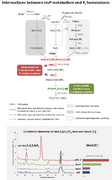
Emerging studies have implicated a close link between inositol phosphate (InsP) metabolism and cellular phosphate (Pi) homeostasis in eukaryotes; however, whether a common InsP species is deployed as an evolutionarily conserved metabolic me...

Evolution of microRNA827 targeting in the plant kingdom
Unlike most ancient microRNAs, which conservatively target homologous genes across species, microRNA827 (miR827) targets two different types of SPX (SYG1/PHO81/XPR1)-domain-containing genes, NITROGEN LIMITATION ADAPTATION (NLA) and PHOSPHAT...
Role of vacuoles in phosphorus storage and remobilization
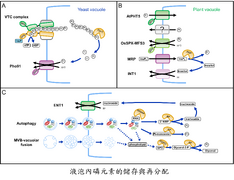
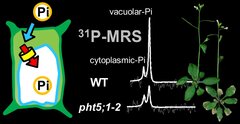
Vacuoles play a fundamental role in storage and remobilization of various nutrients, including phosphorus (P), an essential element for cell growth and development. Cells acquire P primarily in the form of inorganic orthophosphate (Pi). How...
Identification of plant vacuolar transporters mediating phosphate storage
Plant vacuoles serve as the primary intracellular compartments for inorganic phosphate (Pi) storage. Passage of Pi across vacuolar membranes plays a critical role in buffering the cytoplasmic Pi level against fluctuations of external Pi and...
Arabidopsis inositol pentakisphosphate 2-kinase, AtIPK1, is required for growth and modulates phosphate homeostasis at the transcriptional level
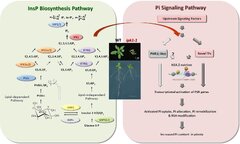
Arabidopsis inositol pentakisphosphate 2-kinase, AtIPK1, is required for growth and modulates phosphate homeostasis at the transcriptional levelInositol hexakisphosphate (IP6) provides a phosphorous reservoir in plant seeds; in addition, al...
MicroRNA-mediated surveillance of phosphate transporters on the move
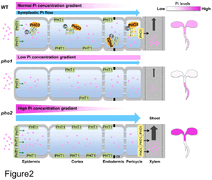
Phosphate (Pi), which is indispensable for the structural and metabolic needs of plants, is acquired and translocated by Pi transporters. Deciphering the regulatory network of Pi signaling and homeostasis that involves the control of Pi tra...
Long-distance call from phosphate: systemic regulation of phosphate starvation responses
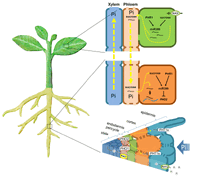
Phosphate (Pi) is an essential nutrient for plants but is normally fixed in soil, which limits plant growth and reproduction. In response to low availability of Pi, shoots and roots react differently but cooperatively to improve Pi acquisit...
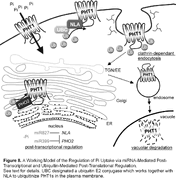
NITROGEN LIMITATION ADAPTATION, a Target of MicroRNA827, Mediates Degradation of Plasma Membrane–Localized Phosphate Transporters to Maintain Phosphate Homeostasis in Arabidopsis
Members of the Arabidopsis thaliana PHOSPHATE TRANSPORTER1 (PHT1) family are key players in acquisition of Pi from the rhizosphere, and their regulation is indispensable for the maintenance of cellular Pi homeostasis. Here, we reveal posttr...

Identification of Downstream Components of Ubiquitin-Conjugating Enzyme PHOSPHATE2 by Quantitative Membrane Proteomics in Arabidopsis Roots
MicroRNA399-mediated regulation of the ubiquitin-conjugating enzyme UBC24/PHOSPHATE2 (PHO2) is crucial for Pi acquisition and translocation in plants. Because of a potential role for PHO2 in protein degradation and its association with memb...
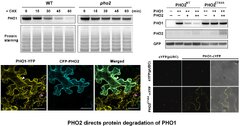
PHO2-Dependent Degradation of PHO1 Modulates Phosphate Homeostasis in Arabidopsis
The Arabidopsis pho2 mutant, which is defective in a ubiquitin-conjugating E2 enzyme, displays Pi toxicity as a result of enhanced uptake and root-to-shoot translocation of Pi To elucidate downstream components of the PHO2-dependent regulat...

The Role of MicroRNAs in Phosphorus Deficiency Signaling
As an essential macronutrient for plant growth, development, and reproduction, phosphorus (P) is a basic component of cellular structures, functions in energy metabolism and signal transduction cascades, and regulates enzymatic activities. ...
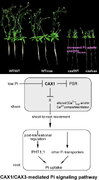
Vacuolar Ca2+/H+ Transport Activity Is Required for Systemic Phosphate Homeostasis Involving Shoot-to-Root Signaling in Arabidopsis
Calcium ions (Ca2+) and Ca2+-related proteins mediate a wide array of downstream processes involved in plant responses to abiotic stresses. In Arabidopsis (Arabidopsis thaliana), disruption of the vacuolar Ca2+/H+ transporters CAX1 and CAX3...
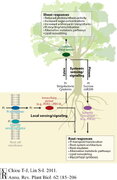
Signaling Network in Sensing Phosphate Availability in Plants
Plants acquire phosphorus in the form of phosphate (Pi), the concentration of which is often limited for plant uptake. Plants have developed diverse responses to conserve and remobilize internal Pi and to enhance Pi acquisition to secure th...