3D imaging of tapetal mitochondria suggests the importance of mitochondrial fission in pollen growth
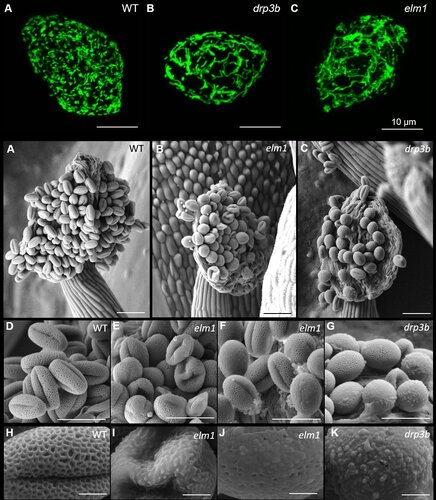
Mitochondrial fission occurring frequently regulates mitochondrial morphology and number in plant cells. However, the biological significance of mitochondrial fission is less understands. Here, we revealed that the production of viable pollen was reduced in elm1, drp3a and drp3b. Mutant pollen had abnormal pollen outer wall and lipid accumulation on pollen surface, mainly associated with tapetum function. Furthermore, we isolated single tapetal cells for which on-site morphology and volume of cells and mitochondria were preserved and quantified features of cells and mitochondria of wild-type and mutant tapetal cells at different stages. Our results showed that in wild type, tapetum volume was gradually increased until vacuolated pollen (VP) stage and remained unchanged at binucleate (BN) and tricelullar (TC) stage; mitochondrial density per tapetal cell was increased until VP and dramatically declined at BN stage which mitochondria became fragmented and swollen. However, defect in mitochondrial fission made tapetal mitochondria elongated and reduced in amount. In addition, mitochondrial fission mutants displayed abnormal nuclear number in developing pollen, implied that cellular processes in pollen was disordered as well. Our study suggest that mitochondrial fission is required for maintaining proper mitochondrial status linked to cellular processes in the tapetum and pollen, important for the production of viable pollen.
Pei-Ying Chen1, Chia-Chen Wu1, Chun-Chi Lin, Wann-Neng Jane,
Der-Fen Suen
* (2019) 3D imaging of tapetal mitochondria suggests the importance of mitochondrial fission in pollen growth Plant Physiol, 813–826