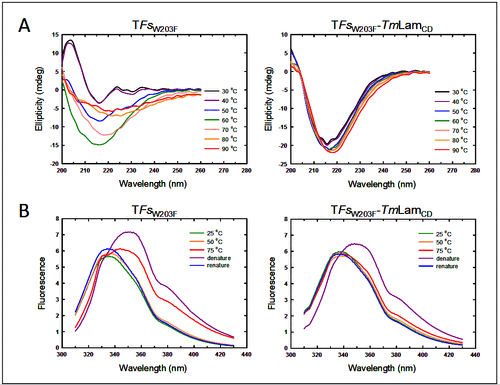
1,3-1,4-β-D-Glucanase (lichenase) and 1,3-β-D-glucanase (laminarinase) are fibrolytic enzymes which play an important role in the hydrolysis of polysaccharide components. Both of these glucanases have been employed in a number of industrial applications. This study aims to improve or combine the novel properties of both glucanases in an attempt to create desirable hybrid enzymes with economic benefits for industrial applications. A truncated and mutated 1,3-1,4-β-D-glucanase gene (TFsW203F) from Fibrobacter succinogenes, and a 1,3-β-D-glucanase gene (TmLam) from hyperthermophilic Thermotoga maritima were used as target enzymes. The substrate binding domains (TmB1 and TmB2) and the catalytic domain (TmLamCD) of TmLam were ligated to the N- or C-terminus of TFsW203F to create four hybrid enzymes, TmB1-TFsW203F, TFsW203F-TmB2, TmB1-TFsW203F-TmB2, and TFsW203F-TmLamCD. The results obtained from kinetic studies show that increased specific activities and turnover rate for lichenan and laminarin were observed in TmB1-TFsW203F-TmB2 and TFsW203F-TmLamCD respectively. Furthermore, fluorescence and CD spectrometric analyses indicated that the hybrid TFsW203F-TmLamCD was structurally more stable than the parental TFsW203F, which was attributed to an improved thermal tolerance of the hybrid enzyme. This study has been successful in creating bifunctional hybrid glucanases with dual substrate catalytic functions which warrant further evaluation of their possible use in industrial applications.
Wei-Chun Liu, Yu-Shiun Lin, Wen-Yih Jeng, Je-Hsin Chen, Andrew H.-J. Wang, and
Lie-Fen Shyur
(2012) Engineering of dual functional hybrid glucanases Protein Engineering, Design and Selection, 25(11):771-780