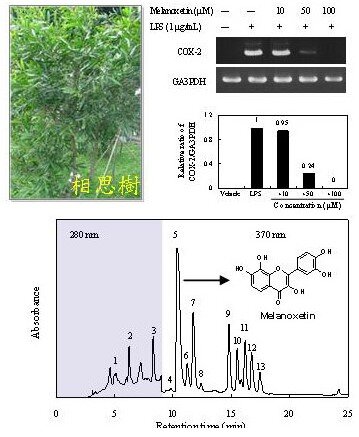
Effect of phytocompounds from the heartwood of Acacia confusa on inflammatory mediator production.
Acacia confusa Merr. (Leguminosae), a species indigenous to Taiwan, is widely distributed on the hills and lowlands of Taiwan. It represents a traditionally important commodity used for charcoal-making and construction materials, as well as used as a traditional herbal medicine for wounding, snake bites, etc. In our previous studies we observed that the heartwood extracts of Acacia confusa have higher phenolics content than that of the bark extracts. In the present study, 13 specific phenolics including 5 new flavonoids were isolated and identified from the heartwood extracts of A. confusa. Melanoxetin (3,7,8,3',4'-pentahydroxyflavone), a major compound in the heartwood extracts, markedly suppressed LPS-induced nitric oxide (NO) and prostaglandin E2 (PGE2) production in murine macrophages. Moreover, melanoxetin drastically (>80%) suppressed gene expression of inducible NO synthase (iNOS) and cyclooxygenase-2 (COX-2) at a concentration of 50?M. This is the first report to identify the inhibitory bioactivities of phytochemicals from A. confusa on important proinflammatory mediators such as NO, PGE2, and COX-2.
Wu, J. H., Tung, Y. T., Chien, S. C., Wang, S. Y., Kuo, Y. H., Shyur, L. F.*
(2008) Effect of phytocompounds from the heartwood of Acacia confusa on inflammatory mediator production.
J. Agric. Food Chem, 56, 1567-1573