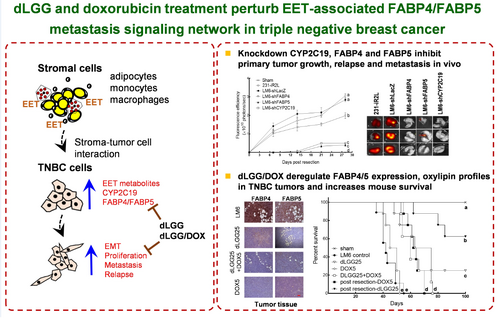
Deregulating the CYP2C19/epoxy-eicosatrienoic acid-associated FABP4/FABP5 signaling network as a therapeutic approach for metastatic triple-negative breast cancer
Recurrence and metastasis are the main causes of triple-negative breast cancer (TNBC) mortality. We have previously demonstrated that arachidonic acid-derived epoxy-eicosatrienoic acids (EETs) are important metastasis drivers in TNBC tumors from that we hypothesized that understanding the interplay between fatty acid binding protein (FABP) and EET-driven metastatic progression may uncover a new opportunity for TNBC intervention. In this work, the biological and clinical relevance of FABP upregulation in the EET signaling axis was deciphered. Publicly available genomics and clinical datasets, shRNA-mediated gene knockdown, EET supplementation, cancer and stromal cell co-cultures, and an orthotopic and resection xenograft tumor mouse model were used to delineate mechanisms by which FABP/EET dynamics and levels were critical in TNBC metastatic transformation and stromal cell interactions. TNBC cell proliferation, migratory transformation, and distal metastasis priming were influenced by EET-associated nuclear translocation of FABP4 and FABP5 isoforms and nuclear accumulation of SREBP-2 or PPAR-γ. Most notably, this study uncovers novel bioefficacy and modes of action of the anticancer drug doxorubicin and a bioactive phytogalactolipid, 1,2-di-O-α-linolenoyl-3-O-β-galactopyranosyl-sn-glycerol (dLGG) identified from medicinal plant Crassocephalum rabens. This study introduces a novel approach to combating TNBC by targeting the FABP/EET/CYP-associated metastatic signaling network.
Apaya MK, Hsiao PW, Yang YC and Shyur LF* (2020) Deregulating the CYP2C19/epoxy-eicosatrienoic acid-associated FABP4/FABP5 signaling network as a therapeutic approach for metastatic triple-negative breast cancer Cancers, 12(1):199