
High-efficiency CRISPR/Cas-based editing of Phalaenopsis orchid MADS genes
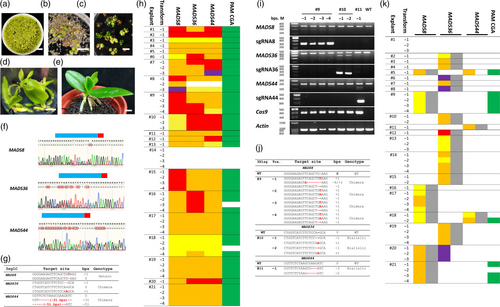
We investigated the orchid MADS gene family, which encodes DNA‐binding proteins that are highly expressed in floral organs and may be important for flower initiation and development (Lin et al., 2016). The Phalaenopsis MADS gene family includes more than 50 members (Chao et al., 2018). As it is challenging to obtain different combinations of mutants in perennial plants such as Phalaenopsis using traditional crosses, there is great interest in developing alternative techniques for gene family studies. We used two CRISPR/Cas strategies to generate single-, double-, and triple- mutants in Phalaenopsis equestris MADS genes (MADS8, MADS36, MADS44).
The PAM sequence of SpCas9 is NRG. Notably, MADS44 contains a sequence similar to the MADS8 target sequence but with a CGA PAM. In our experiment, this PAM CGA target site was edited. Given current public concerns about genetically modified organisms (GMOs), methods to perform gene editing without transgenic gene integration are highly desirable. In this study, we obtained MADS‐null mutants of Phalaenopsis, this protocol has potential applications for gene family studies in other perennial plants.
Chii‐Gong Tong, Fu‐Hui Wu, Yu‐Hsuan Yuan, Yan‐Ru Chen, Choun‐Sea Lin (2019) High-efficiency CRISPR/Cas-based editing of Phalaenopsis orchid MADS genes Plant Biotechnology Journal