Common and Distinct Functions of Arabidopsis Class A1 and A2 Heat Shock Factors in Diverse Abiotic Stress Responses and Development
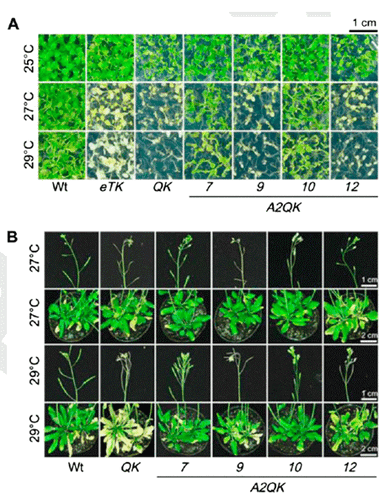
There are 21 heat-shock factor (HSF) homologs in Arabidopsis thaliana, of which members of class A1 (HSFA1a/b/d/e) play the major role in activating the transcription of heat-induced genes including HSFA2. Once induced, HSFA2 becomes the dominant HSF and is able to form hetero-oligomeric complexes with HSFA1. However, whether HSFA2 could function independently as a transcription regulator in the absence of the HSFA1s was undetermined. To address this question, we introduced a 35Spro:HSFA2 construct into hsfa1a/b/d/e quadruple knockout (QK) and wild-type (Wt) backgrounds to yield transgenic lines A2QK and A2Wt, respectively. Constitutive expression of HSFA2 rescued the developmental defects of the QK mutant, and promoted callus formation in A2QK, but not in A2Wt, after heat treatment. Transcriptome analysis showed that heat stress response genes are differentially regulated by the HSFA1s and HSFA2; the genes involved in metabolism and redox homeostasis are preferentially regulated by HSFA2, while HSFA1s-preferring genes are enriched in transcription function. Ectopic expression of HSFA2 complemented the defects of QK in tolerance to different heat stress regimes, and to H2O2, but not to salt and osmotic stresses. Furthermore, we showed that HSFA1a/b/d are involved in thermotolerance to mild heat stress at temperatures as low as 27°C. We also noticed subfunctionalization of the four Arabidopsis A1-type HSFs in diverse abiotic stress responses. Overall, this study reveals the overlapping and distinct functions of class A1 and A2 HSFs, and may enable more precise use of HSFs in engineering stress tolerance in the future.
Liu HC, Charng YY (2013) Common and Distinct Functions of Arabidopsis Class A1 and A2 Heat Shock Factors in Diverse Abiotic Stress Responses and Development Plant Physiology, 163: 276-290