Hepatoprotective phytocompounds from Cryptomeria japonica are potent modulators of inflammatory mediators
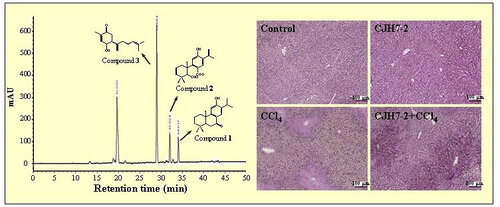
Cryptomeria japonica (Taxodiaceae) is an important plantation conifer tree in Asia. This study aimed to characterize the anti-inflammatory and hepatoprotective activities of the phytocompounds from C. japonica wood on LPS- or TPA-induced activation of proinflammatory mediators and CCl4-induced acute liver injury in mice. A CJH7-2 fraction was purified from C. japonica extracts following bioactivity-guided fractionation, and it exhibited significant activities on inhibition of NO production and iNOS expression as well as up-regulating HO-1 expression in LPS-stimulated macrophages. CJH7-2 also potently inhibits COX-2 enzymatic activity (IC50 = 5μg/mL) and TPA-induced COX-2 protein expression in mouse skin (1 mg/200μL/site). CJH7-2 (10 mg/kg BW) can prevent CCl4-induced liver injury and aminotransferases activities in mice. Chemical fingerprinting analysis showed that terpenes are the major bioactive compounds in the CJH7-2 fraction. This is the first study to demonstrate that chemical constituents from wood extract of C. japonica possess anti-inflammatory activity in vitro and in vivo that may play a role in hepatoprotection.
Shyur, L. F.*, Huang, C. C., Lo, C. P., Chiu, C. Y., Chen, Y. P., Wang, S. Y., Chang, S. T (2008) Hepatoprotective phytocompounds from Cryptomeria japonica are potent modulators of inflammatory mediators Phytochemistry, 69, 1348-1358