

Research Focus
Regulatory Network in Sensing Phosphate Availability in Plants
Phosphorus (P) is an essential mineral nutrient required for plant growth and development, but its availability in the form of phosphate (Pi) in the soil is limited. To overcome this constraint, plants have evolved complex regulatory networks and multiple strategies to enhance external Pi uptake and to conserve and remobilize internal Pi resources.
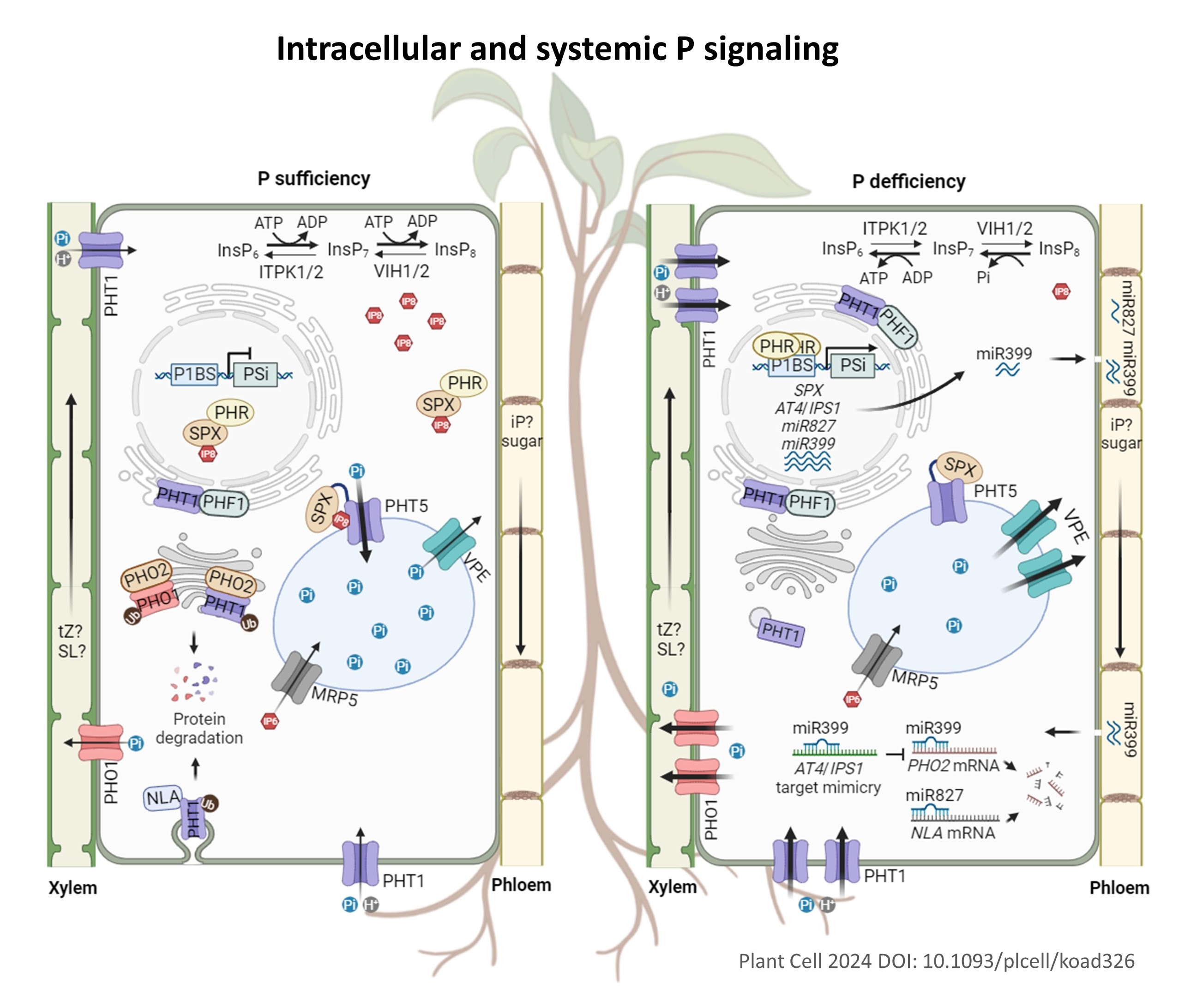
Our research demonstrates that microRNAs (miRNAs)—endogenous, non-coding small RNAs—serve as crucial regulators in plant Pi-starvation responses. Induced by Pi deficiency, miR399 and miR827 post-transcriptionally downregulate their respective target genes: PHOSPHATE2 (PHO2), which encodes a ubiquitin-conjugating E2 enzyme, and NITROGEN LIMITATION ADAPTATION (NLA), which encodes a RING-type ubiquitin-ligating E3 enzyme. PHO2 is localized to the endomembrane system, where it regulates the degradation of both the PHO1 protein and the PHOSPHATE TRANSPORTER1 (PHT1) to coordinate Pi uptake in roots and its translocation to shoots. Meanwhile, NLA localizes to the plasma membrane to regulate PHT1 degradation. Operating independently yet cooperatively, the miR399-PHO2 and miR827-NLA ubiquitination cascades regulate the post-translational abundance of two Pi transporters. This miRNA-mediated surveillance lies at the core of maintaining cellular Pi homeostasis in response to fluctuating soil Pi levels. Beyond their predominant role in root Pi absorption, we study the vital role of these Pi transporters in seed and anther development for reproductive success.
Inside plant cells, Pi is primarily stored in the vacuole, which acts as a buffer to maintain stable cytoplasmic Pi concentrations. Our team identified members of the SPX-MFS family (PHT5 Pi transporter family) as the long-sought-after vacuolar Pi importers. This finding provides compelling evidence for their essential role in vacuolar Pi sequestration and in maintaining cytoplasmic Pi homeostasis. Furthermore, we show that "cytoplasmic" Pi concentrations directly regulate the expression of most Pi starvation-responsive genes, offering a new perspective on how plants coordinate vacuolar Pi transport with cellular metabolism and environmental changes.
Additionally, we investigate the role of inositol phosphates in Pi signaling and explore the molecular pathways underlying the systemic regulation of Pi-starvation responses. By employing genome-wide association studies (GWAS) and transcriptome-wide association studies (TWAS) in natural accessions, we continue to identify novel regulatory genes associated with Pi acquisition and utilization. Ultimately, these insights hold great potential to improve crop P use efficiency and achieve sustainable agricultural production in the future.

Tzyy-Jen Chiou
Distinguished Research Fellow
(02) 2787-2051
tjchiou@gate.sinica.edu.tw
A530, Agricultural Technology Building
Lab.
A525, Agricultural Technology Building
Tel: (02) 2787-2051
- 1995 Ph.D. Physiological and Molecular Plant Biology Program, Univ. of Illinois, USA
- 1995-1997 PDF Dept. of Plant Biology, Univ. of Illinois, USA
- 1997-1998 PDF Dept. of Food Science, Univ. of Illinois, USA
- 1998-2000 PDF Plant Biology Div., Noble Foundation, USA
- 2000-2007 Assistant Research Fellow Inst. of BioAgric. Sci., Academia Sinica
- 2007-2012 Associate Research Fellow
- 2012-2018 Research Fellow
- 2014-2016 Vice Director
- 2018-Distinguished Research Fellow
- 2018-Deputy Executive Secretary